
Granulation Machinery / Blending Machines
V Blender
V-shaped dry powder blender with polished product-contact parts and model-specific working volumes. Engineered by Technogen Enterprise, Ahmedabad, India.
ISO 9001:2015Ahmedabad, IndiaManufacturer - Exporter
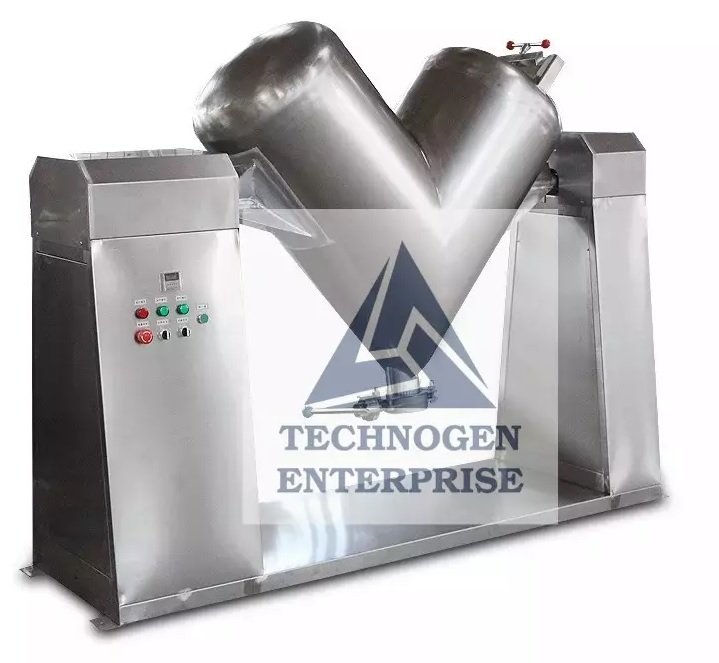
V BlenderMachine image shown for reference. Final configuration is selected against the approved application and production requirement.
01
Machine Overview
The V Blender from Technogen Enterprise is designed for batch blending of free-flowing dry powders and granular materials. Its familiar V-shaped vessel is formed from two cylindrical shells that meet at an angle. As the vessel rotates, ingredients are repeatedly separated and recombined, making the machine appropriate for applications requiring homogeneous blends while limiting aggressive particle handling.
Manufactured in Ahmedabad, India, Technogen Enterprise supplies and exports V Cone Blenders for pharmaceutical, nutraceutical, food and chemical processing. The equipment description places emphasis on robust support construction, polished product-contact surfaces and straightforward charging and discharge. SS 316L is identified for contact parts, with SS 304 available to suit specific customer requirements. The machine can also be fitted with intensifier bars when powder de-agglomeration is needed, making configuration selection important.
The product specificationed TGVB series includes different gross and working capacities as well as overall dimensions and motor ratings. Because blend behaviour depends on particle size distribution, material density and flow, model choice should account for usable fill volume and the required processing cycle. A V Blender Machine is particularly relevant where dry ingredients must be mixed repeatedly and reliably, yet shear exposure should be managed. Technogen Enterprise can evaluate vessel size, materials of construction and any optional processing attachments against the buyer's formulation.
02
Applications
03
Operating Principle
A V Blender mixes by rotating its connected cylindrical shells. As the vessel passes through successive orientations, powder moves towards the V junction and then separates again into the two arms. These cycles of convergence and division redistribute the batch and gradually improve mixture uniformity.
Product Charging
Dry ingredients are loaded into the V-shaped vessel through the provided openings. The working volume is selected according to actual bulk density and blend properties, leaving the free space needed for tumbling action.
Vessel Rotation
The motor and drive rotate the blender on its supporting trunnions. The two inclined shells change orientation continuously, producing material motion along the internal vessel surfaces.
Mixing by Division and Recombination
During every rotation, a portion of the batch moves towards the common junction while another portion moves into the opposing arm. Repetition of this converging and diverging motion promotes dry blending.
Optional De-agglomeration
When supplied with intensifier bars, the unit may apply additional local action to break down selected soft agglomerates. These attachments are not assumed to be fitted to every standard machine.
Discharge and Cleaning
The operator stops the unit, positions it correctly and opens the specified butterfly discharge arrangement. Internal polishing supports subsequent cleaning, while the absence of a conventional central mixing shaft reduces potential hold-up areas.
Process Selection Consideration
For fragile powders, the correct rotation settings and loading method help manage unwanted attrition. The blending process should be checked against the required uniformity without treating any quoted cycle time as guaranteed.
04
Salient Features
V-shaped twin-shell vessel for dry powder and granule blending
Gentle converging and diverging movement during rotation
Sturdy machine structure with heavy-duty support stand
SS 316L product-contact construction stated in standard features
Alternative SS 304 product-contact construction on requirement
Mirror-polished product-contact surfaces
Matt-polished exterior surfaces
Hand-operated butterfly discharge valves
Safety railings integrated into specified design
Cast and assembled machine with motors and controls
Minimal internal mechanical blade action for sensitive materials
Manual hand-wheel rotation feature described in the specified configuration
Convenient batch charging, discharge and cleaning
05
Technical Specifications
Final specifications may vary with container size, product characteristics, selected model and approved configuration.
| MODEL – | Gross Capacity in ltrs – | Working Capacity in Ltrs – | OVERALL DIMENSIONS | OVERALL DIMENSIONS | OVERALL DIMENSIONS | HP |
|---|---|---|---|---|---|---|
| MODEL – | Gross Capacity in ltrs – | Working Capacity in Ltrs – | Length | Width | Height | – |
| TGVB-25 | 50 | 30 | 1100 | 760 | 1375 | 1.5 |
| TGVB-50 | 100 | 55 | 1400 | 760 | 1575 | 2.0 |
| TGVB-100 | 200 | 110 | 1525 | 1000 | 2450 | 2.5 |
| TGVB-250 | 500 | 280 | 1850 | 1100 | 2770 | 7.5 |
| TGVB-500 | 1000 | 560 | 2000 | 1250 | 3800 | 10.0 |
| TGVB-1000 | 1850 | 1200 | 2300 | 1400 | 4200 | 15.0 |
06
Add-On Features
Intensifier bars for de-agglomeration
SS 304 contact material option in place of SS 316L
07
Applicable Industries
08
Frequently Asked Questions
How does a V Blender achieve mixing?
The rotating V-shaped shells repeatedly divide and recombine the powder mass. This recurring motion promotes blend uniformity through gentle tumbling rather than continuous high-speed blade mixing.
What products can be processed?
The product specification specifies dry free-flowing solids, especially powders and granules. Sticky, wet or highly cohesive materials need a separate suitability assessment.
Can an intensifier bar be added?
The technical specification describes intensifier bars for de-agglomeration. Their inclusion should be specified according to the formulation because an intensifier changes the mechanical action on the material.
Which stainless steel grades are available?
The feature list identifies SS 316L contact parts and an SS 304 alternative. The selected material grade should be confirmed in the supply specification.
What information is needed for model selection?
Provide batch weight, bulk density, particle characteristics, intended blending time and preferred contact material. The technical table then assists with choosing working capacity and motor size.
Related Machinery
Continue building your line.
Drying Machines
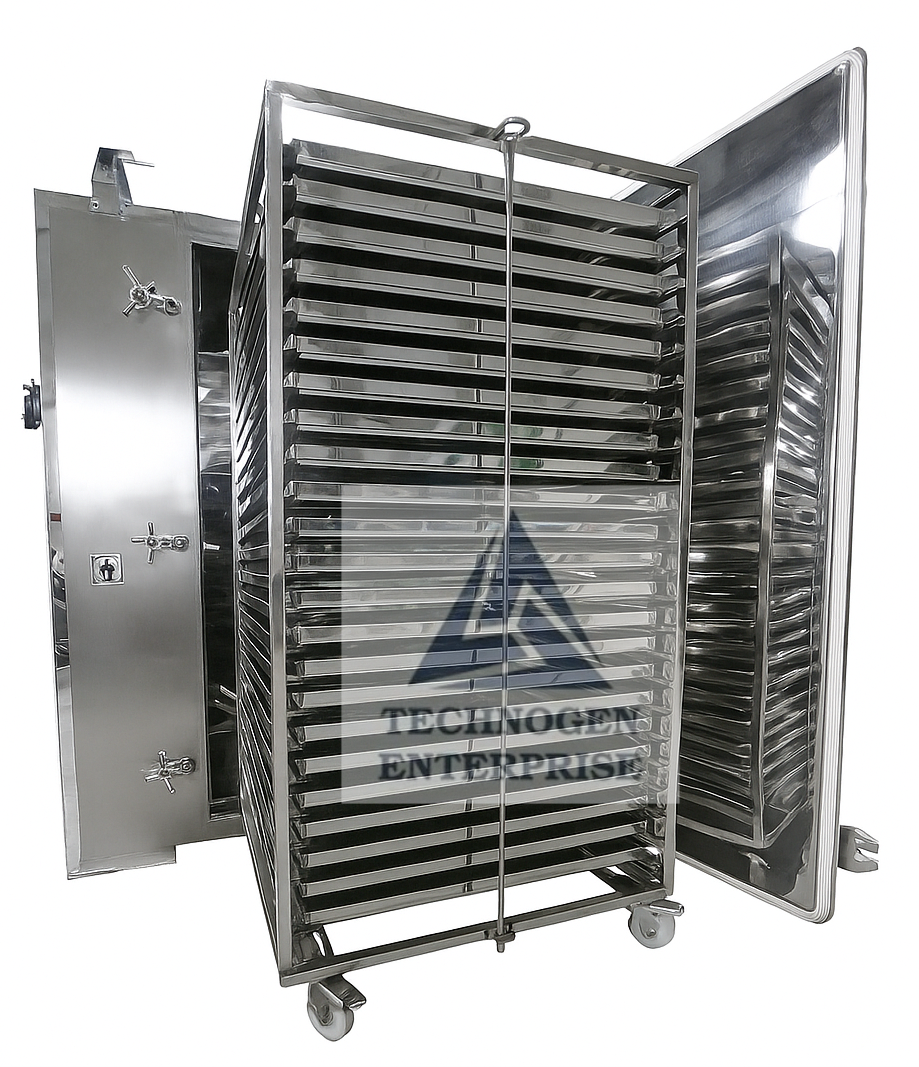
Air Tray Dryer
Insulated batch hot-air tray dryer with TGTD-24, TGTD-48 and TGTD-96 configurations. Engineered by Technogen Enterprise, Ahmedabad, India.
Blending Machines
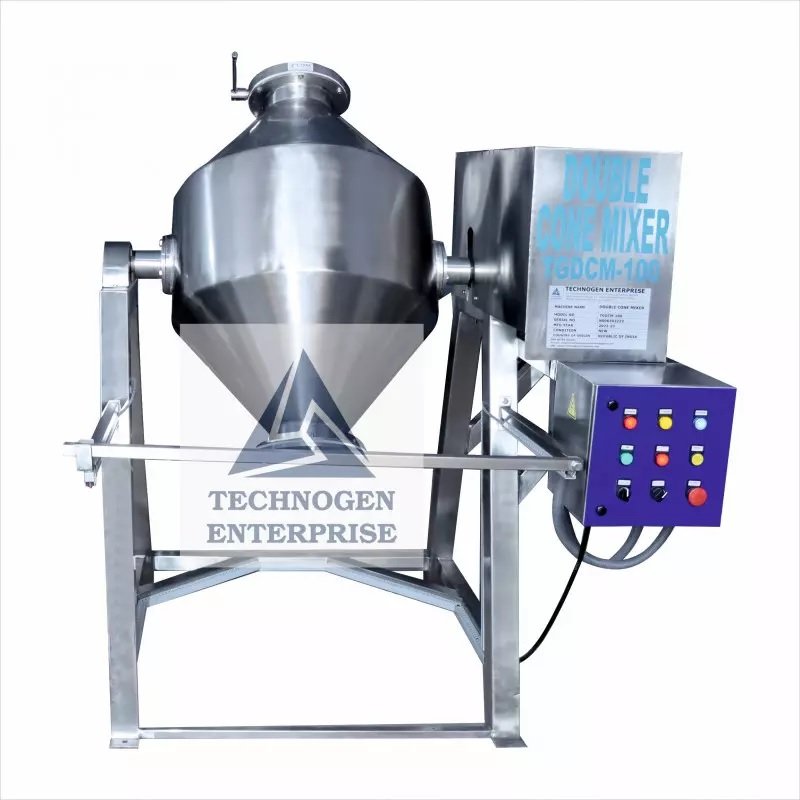
Double Cone Blender
Dry powder and granule blender with double-conical rotating chamber and model-dependent stainless steel construction. Engineered by Technogen Enterprise, Ahmedabad, India.
Drying Machines
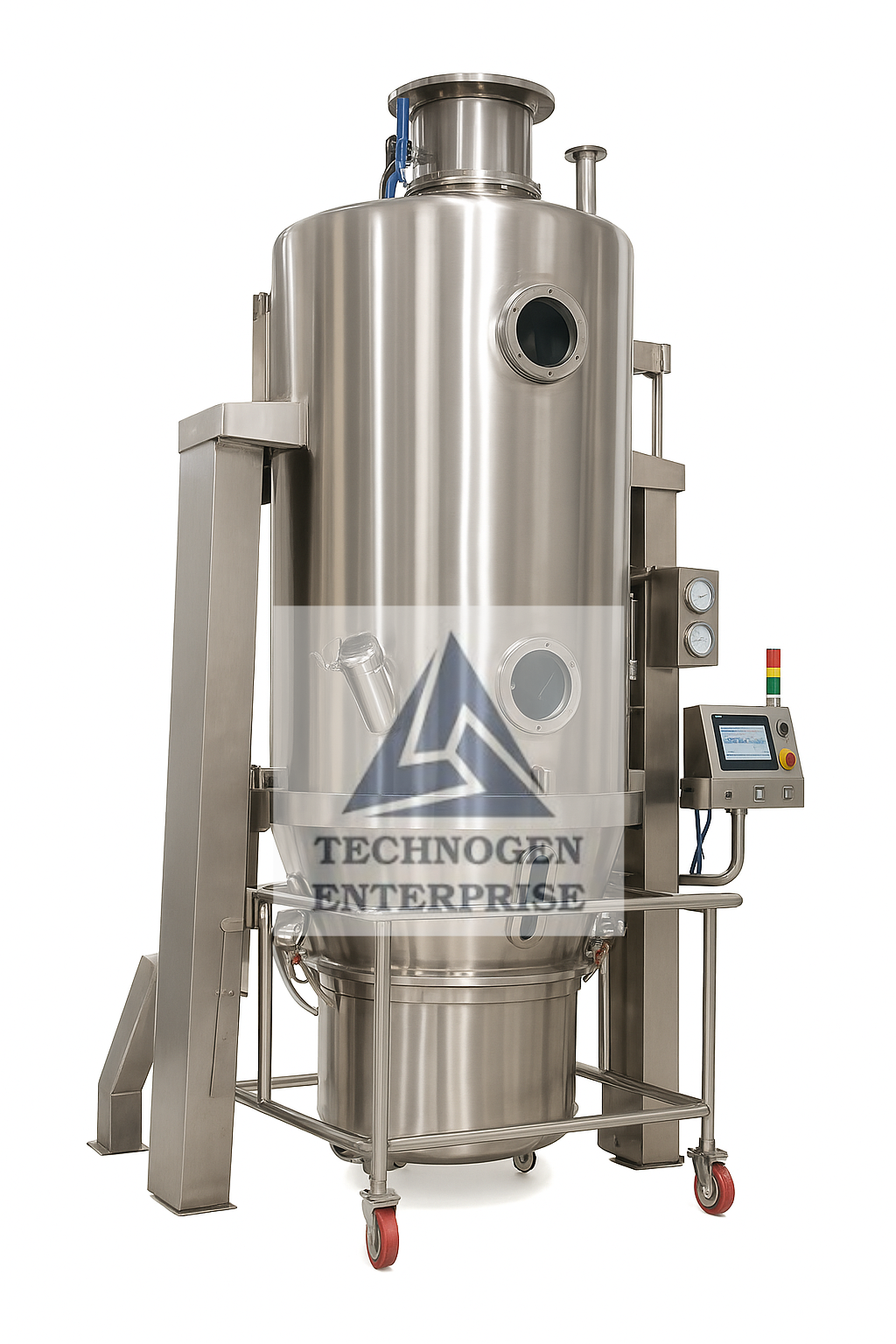
Fluid Bed Dryer
Fluidised-bed batch dryer for granules and powders with TGFBD models and controlled heated airflow. Engineered by Technogen Enterprise, Ahmedabad, India.
Request Technical Quote
Discuss V Blender with our engineering team.
Share batch size, bulk density, material grade and whether intensifier bars are needed for your V Blender quotation.