
Granulation Machinery / Blending Machines
Double Cone Blender
Dry powder and granule blender with double-conical rotating chamber and model-dependent stainless steel construction. Engineered by Technogen Enterprise, Ahmedabad, India.
ISO 9001:2015Ahmedabad, IndiaManufacturer - Exporter
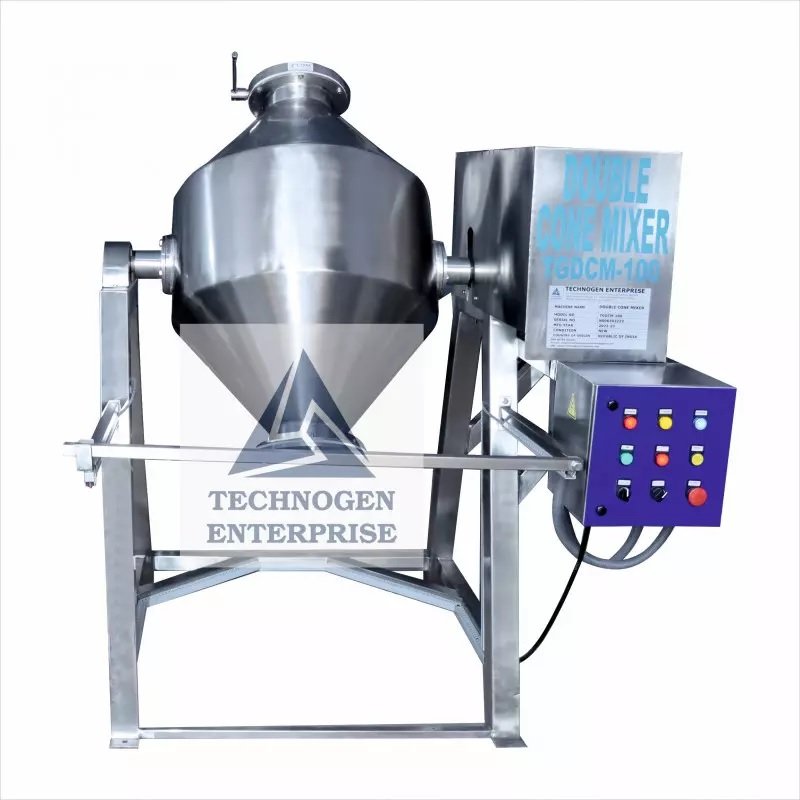
Double Cone BlenderMachine image shown for reference. Final configuration is selected against the approved application and production requirement.
01
Machine Overview
Technogen Enterprise manufactures Double Cone Blenders in Ahmedabad, India, for the controlled blending of dry powders, granules and other free-flowing solid ingredients. As a manufacturer, supplier and exporter, we offer an industrial mixing solution for pharmaceutical, food, chemical and cosmetic production where blend consistency and careful material handling are important. The rotating, double-conical vessel repeatedly divides and recombines the batch without relying on a high-shear impeller. This gentle tumbling action is especially relevant to dry blends that must be mixed thoroughly without aggressive mechanical processing.
The double cone construction supports convenient charging, batch mixing and discharge. Depending on the selected configuration, product-contact components are available in SS 304 or SS 316, with polished surfaces that assist cleaning and reduce product accumulation. A butterfly valve is provided on applicable models for controlled discharge; manual inching, guarding and drive arrangements depend on size and specification. The model range covers different nominal batch capacities, allowing selection for production-scale requirements.
For customers evaluating a double cone blender machine, important selection factors include powder flowability, bulk density, permitted fill volume, blend time, rotational speed, cleaning requirements and discharge height. Technogen Enterprise can review these parameters and recommend a model that fits the process rather than relying on nominal capacity alone.
02
Applications
03
Operating Principle
The Double Cone Blender works through controlled vessel rotation and repeated particle movement. Its two cones are joined at a common central section, producing a changing orientation of the powder bed as the chamber turns. The mixing action is predominantly tumbling and cascading, rather than the intensive shearing used in some other mixing systems.
Material Charging
Dry powders or granules are charged through the designated opening. The practical batch charge is selected according to material bulk density, free volume and the required blending result rather than assuming the entire gross volume can be filled.
Setting the Blend Cycle
The operator sets the rotation conditions and mixing period appropriate to the formulation. The drive and worm-reduction gearbox rotate the vessel at the selected speed; the loading arrangement and guarding are checked before the cycle begins.
Tumbling and Intermixing
As the cones turn, material repeatedly moves between the conical sections. This cascading action redistributes individual components throughout the batch. Internal fixed baffles, where supplied, assist circulation and blending.
Positioning and Discharge
At the end of the cycle, rotation is stopped and the vessel is positioned for unloading, with manual hand-wheel inching available where specified. Product exits through the designated discharge arrangement, including a butterfly valve on applicable sizes.
Cleaning and Changeover
After the batch has been discharged, the charging opening, discharge valve, product-contact surfaces and gaskets are cleaned under the plant's procedure before the next product or formulation.
04
Salient Features
Double-cone vessel geometry for gentle dry-powder and granule blending
CGMP-style construction with SS 304 general framework on specified models
SS 304 or SS 316 product-contact parts according to selected construction
Mirror-polished vessel surfaces to assist hygienic cleaning
Butterfly discharge valve on applicable blender capacities
Worm reduction gearbox for controlled vessel rotation
Manual hand-wheel inching facility for positioning, where specified
Fixed internal baffles with polished finish as described in machine design
Adjustable blending time and rotation speed according to configuration
Front SS 304 pipe safety guarding with limit switch on specified models
Rear safety rods described in the equipment design
Food-grade rubber gaskets on cone openings and butterfly valve
Left-hand or right-hand drive configuration can be specified
05
Technical Specifications
Final specifications may vary with container size, product characteristics, selected model and approved configuration.
| PARTICULAR | SPECIFICATION | SPECIFICATION | SPECIFICATION | SPECIFICATION | SPECIFICATION | SPECIFICATION | SPECIFICATION | SPECIFICATION |
|---|---|---|---|---|---|---|---|---|
| Capacity / KG | 10 | 25 | 50 | 100 | 150 | 200 | 250 | 300 |
| Gross Volume | 35 | 80 | 150 | 300 | 450 | 600 | 800 | 900 |
| Volume/Ltrs | 10 | 50 | 100 | 200 | 300 | 400 | 500 | 600 |
| Motor Power (HP) | 0.5 | 1 | 2 | 3 | 5 | 5 | 7.5 | 7.5 |
| Gear Box | 1.75 | 1.75 | 2 | 3 | 4 | 4 | 5 | 5 |
| Butterfly Valve | NA | NA | NA | 200 | 200 | 250 | 250 | 250 |
| Safety Guard | NA | NA | YES | YES | Yes | YES | YES | YES |
| Discharge Height (mm) | 300 | 300 | 450 | 450 | 450 | 450 | 450 | 450 |
06
Add-On Features
Flameproof electrical components for suitable hazardous-area requirements
Dust-free bin charging arrangement
Choice of left-side or right-side drive arrangement
SS 316 product-contact parts where required
07
Machine Interlocks & Safety Features
Front guarding limit switch on models equipped with the specified guard
Rear safety rods described in the technical specification configuration
08
Applicable Industries
09
Frequently Asked Questions
What materials can be blended in a Double Cone Blender?
The machine is intended for dry powders, granules and comparable solid ingredients that respond to tumbling action. Blend suitability depends on particle characteristics, flowability, batch size and formulation requirements.
How does a double cone blender mix ingredients?
Rotation makes material tumble and cascade repeatedly between the two cone sections. This changing powder-bed position promotes intermixing without a conventional high-shear agitator.
Is the blender available with stainless steel product-contact parts?
Yes. The technical specification identifies SS 304 or SS 316 product-contact construction according to the customer's requirement. Material grade should be confirmed in the final technical offer.
What is the role of the butterfly valve?
On models fitted with a butterfly discharge valve, the valve controls release of the blended batch into a receiving container or downstream handling system. The technical specification table shows it is not fitted on every small model.
Can the blender be configured for dust-conscious charging?
A dust-free bin charging system is identified as an available configuration. Its containment arrangement and the plant's powder-handling requirements should be confirmed at enquiry stage.
Related Machinery
Continue building your line.
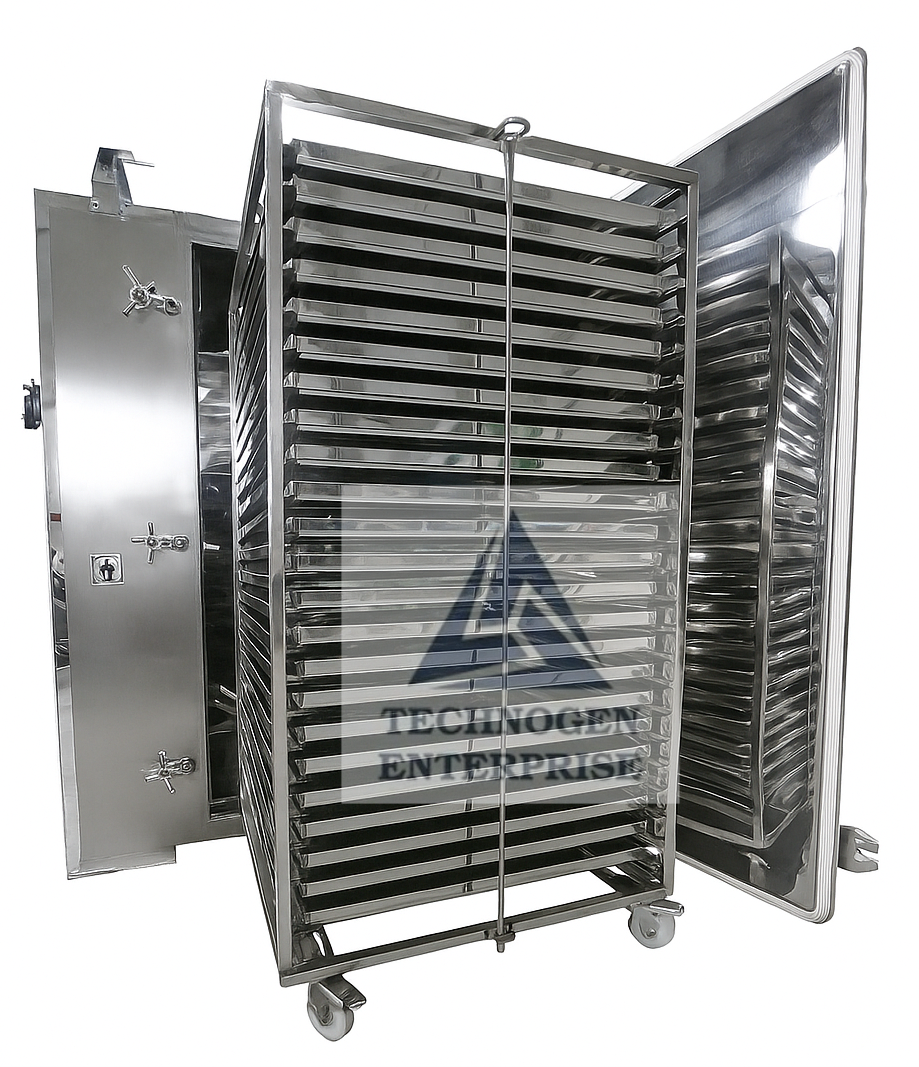
Drying Machines
Air Tray Dryer
Insulated batch hot-air tray dryer with TGTD-24, TGTD-48 and TGTD-96 configurations. Engineered by Technogen Enterprise, Ahmedabad, India.
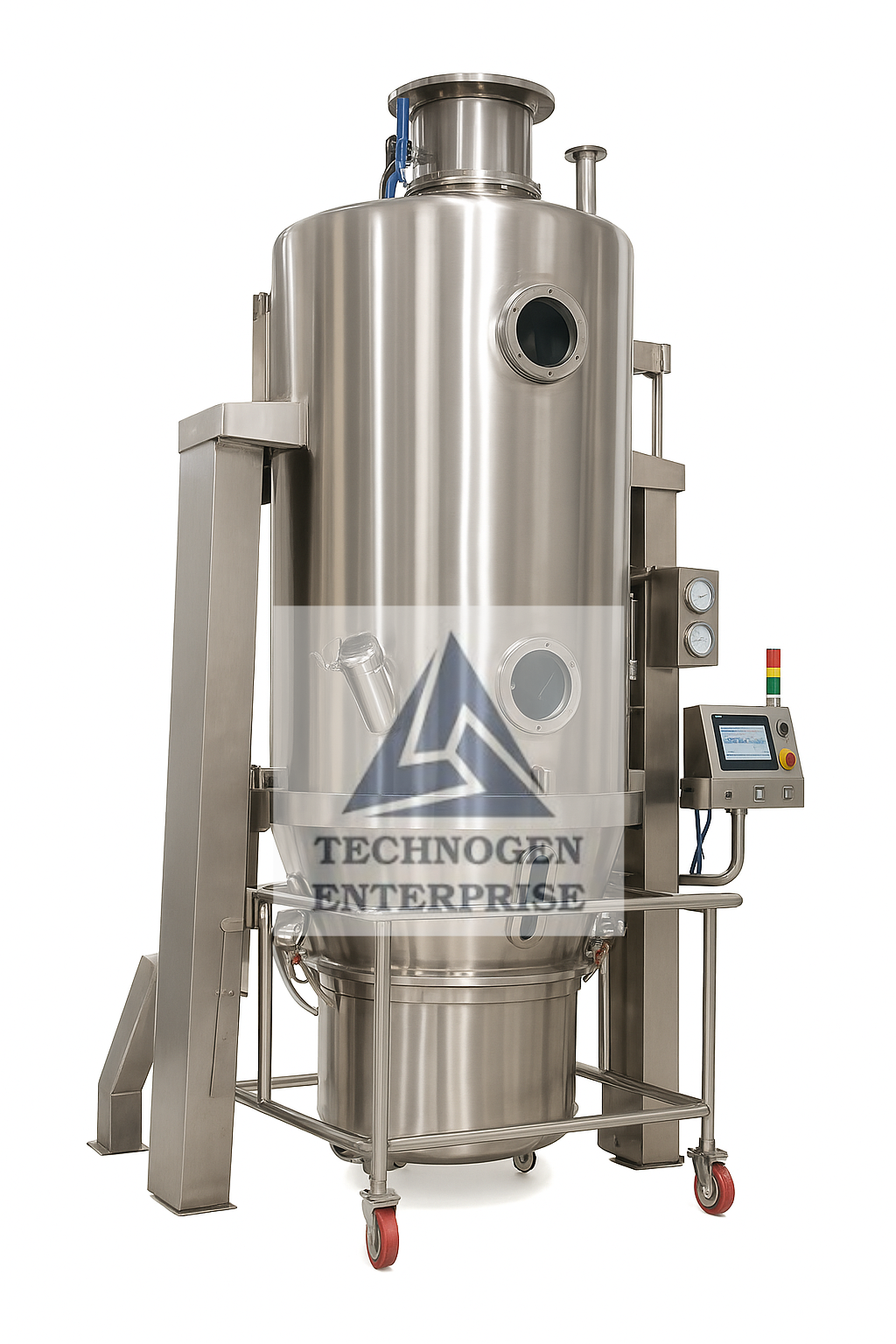
Drying Machines
Fluid Bed Dryer
Fluidised-bed batch dryer for granules and powders with TGFBD models and controlled heated airflow. Engineered by Technogen Enterprise, Ahmedabad, India.
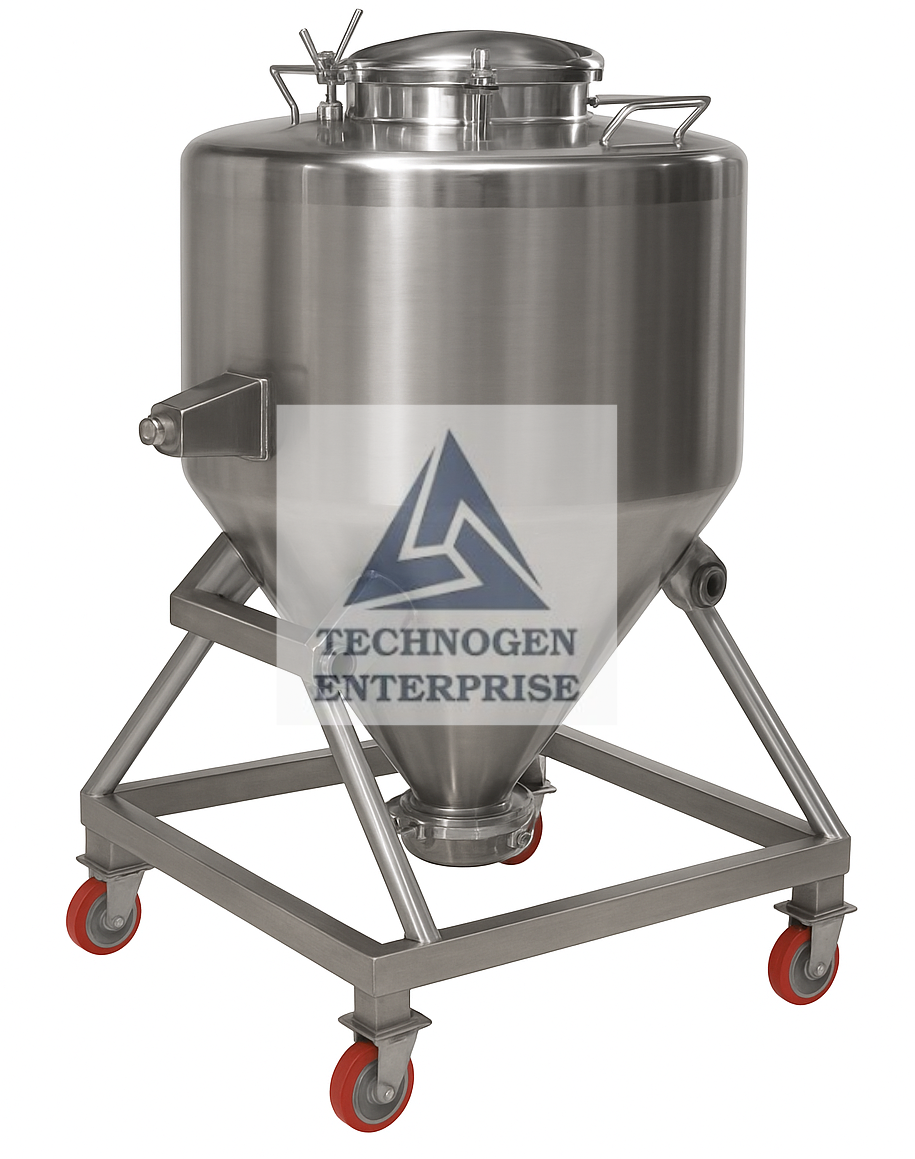
Material Handling Bins
IPC Bins
Integrated Process Container for stainless steel powder storage, internal batch transfer and controlled discharge. Engineered by Technogen Enterprise, Ahmedabad, India.
Request Technical Quote
Discuss Double Cone Blender with our engineering team.
Share your powder properties, batch size and required material grade for a suitable double cone blender proposal.