
Water Bottling Machine / Carbonated Beverage RFC Lines
Automatic Glass RFC Isobaric Carbonated Beverage Filling Machine
Rotary glass-bottle rinsing, counter-pressure filling and crown or ROPP capping monoblock for carbonated beverages. Engineered by Technogen Enterprise, Ahmedabad, India.
ISO 9001:2015Ahmedabad, IndiaManufacturer - Exporter
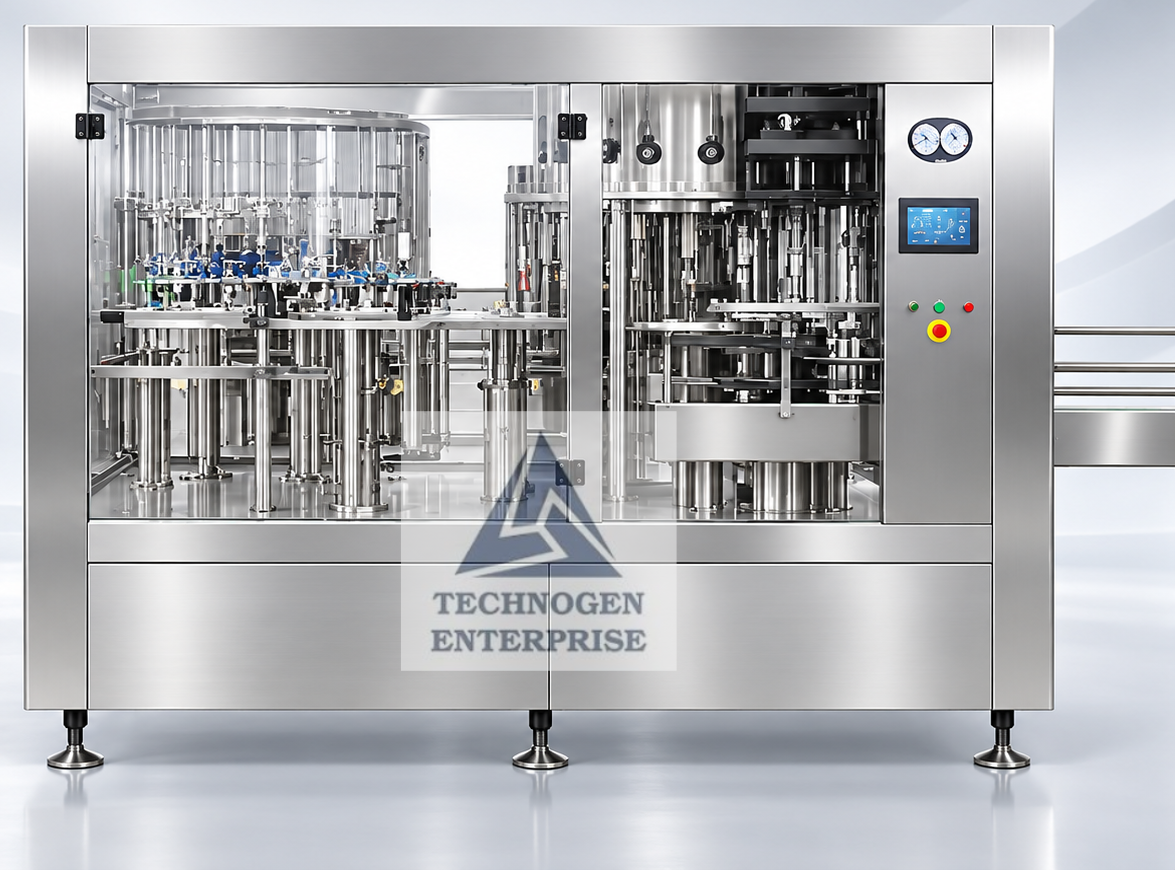
Automatic Glass RFC Isobaric Carbonated Beverage Filling MachineMachine image shown for reference. Final configuration is selected against the approved application and production requirement.
01
Machine Overview
The Automatic Glass Bottle RFC Isobaric Carbonated Beverage Filling Machine from Technogen Enterprise is a rotary monoblock for rinsing, counter-pressure filling and capping carbonated drinks in glass bottles. This integrated configuration is designed for beverage plants where stable carbonation, filling repeatability and a coordinated bottling process are essential. Manufactured in Ahmedabad, India, the system is offered by Technogen Enterprise as a manufacturer, supplier and exporter of carbonated beverage filling machinery.
The product specificationed glass-bottle configuration handles 100–1000 ml containers and has a published output range of 2,000–9,000 bottles per hour, depending on selected turret size and process conditions. The rinsing section prepares the bottle, while the pressurised product circuit and ULTRA mechanical two-step isobaric filling valves control filling under counter-pressure. Glass bottles can then be closed using a crown capping or aluminium ROPP capping system selected for the customer's bottle finish. These capping arrangements are alternatives, not necessarily a combined standard head.
The machine description identifies stainless steel construction in SS 304 or SS 316L, synchronized bottle transfer through starwheels, PLC/HMI operation and interlocked guarding. For suitable configuration, the buyer should supply bottle drawings, cap specifications, beverage carbonation conditions, desired hourly throughput and relevant rinsing, product and CO₂ utilities. This information supports head selection and accurate mechanical matching across all three stations.
02
Applications
03
Operating Principle
The glass-bottle RFC monoblock performs three coordinated operations: internal bottle rinsing, isobaric counter-pressure filling and capping. Its filling section first establishes a suitable pressure relationship between bottle and beverage circuit, allowing a carbonated liquid to enter with less uncontrolled foaming than an atmospheric fill.
Rinsing the Incoming Bottle
Glass containers transfer to a rotary rinsing turret and are held by a compatible neck-handling arrangement. Bottles are inverted or positioned for rinsing and draining. The described No Bottle–No Rinse function avoids an unnecessary rinse stroke at an empty position.
Bottle Sealing and Pressure Equalisation
The bottle moves under an isobaric filling valve and seals to the filling interface. The process establishes the required pressure relationship with CO₂ before liquid transfer.
Controlled Carbonated Filling
The technical specification specifies ULTRA mechanical two-step filling valves. Carbonated beverage enters under counter-pressure, with flow and gas handling arranged to reduce foaming and maintain appropriate filling conditions.
Venting and Release
Gas is released in a controlled manner as required by the filling sequence so that the filled bottle can be disengaged from the filling valve without an abrupt pressure transition.
Glass Bottle Capping
The filled container transfers to the synchronized capping turret. A crown capper or aluminium ROPP capper is fitted according to the bottle finish and project requirement before discharge.
Process Selection Consideration
The final head count is selected from the available rinsing, filling and capping options. Bottle-neck compatibility and the selected closure style are critical to reliable transfer and capping.
04
Salient Features
Integrated rotary rinsing, isobaric filling and capping monoblock
Designed for 100–1000 ml glass bottles
Published output range of 2,000–9,000 bottles per hour
ULTRA mechanical two-step counter-pressure filling valves
Rotary bottle rinsing with neck-handling grippers
Controlled CO₂ pressure equalisation and venting
Choice of crown or aluminium ROPP capping system
Synchronized bottle handling via transfer starwheels
SS 304 or SS 316L construction specified
PLC and HMI machine control
Cleaning-compatible product-contact filling arrangement
Protective doors with safety interlocks
No Bottle–No Rinse arrangement described in the specified configuration
05
Technical Specifications
Final specifications may vary with container size, product characteristics, selected model and approved configuration.
| Parameter | Specification |
|---|---|
| Bottle Material | Glass |
| Bottle Size Range | 100 ml to 1000 ml |
| Output Capacity | 2,000 – 9,000 bottles/hour |
| Rinsing Heads | 8 / 12 / 18 / 24 / 32 |
| Filling Heads | 8/ 12 / 18 / 24 / 32 |
| Capping Heads | 4/ 6 / 8 / 10 |
| Capping Type | Customer choice: Crown Capping or ROPP Aluminium Capping |
| Filling Technology | Isobaric Counter-Pressure Filling |
| Filling Valve Type | ULTRA Mechanical 2-Step |
| CO₂ Pressure Range | 0.2 – 0.3 MPa |
| Rinse Pressure | 0.4 – 0.6 MPa |
| Construction Material | SS304 / SS316L |
| Electrical Supply | 3-Phase, 415V, 50/60 Hz |
| Automation | PLC + HMI |
| Machine Operation | Fully Automatic |
| Safety Features | Interlocking Guard Doors, Sensors, Emergency Stop |
06
Add-On Features
Alternative crown capping or aluminium ROPP capping selection
Automatic no-cap bottle rejection system
Hot-water spray arrangement at machine exit
07
Machine Interlocks & Safety Features
Protective safety-door interlocks
Emergency stop arrangement
Bottle detection and No Bottle–No Rinse logic
08
Applicable Industries
09
Frequently Asked Questions
What bottles can the glass RFC machine process?
The technical specification specifies glass bottles from 100 ml to 1000 ml. Bottle dimensions, neck finish and change-parts requirements must be verified using actual drawings.
What is isobaric filling?
Isobaric filling establishes controlled pressure in the bottle before introducing carbonated liquid. This helps manage foaming and retain carbonation during the filling operation.
Can it use crown and ROPP caps?
The glass model can be configured with either crown capping or aluminium ROPP capping based on the customer's bottle and closure. The quotation must specify which system is supplied.
What output range is stated?
The technical specification lists 2,000–9,000 bottles per hour. Actual capacity depends on the selected rinse, fill and cap head arrangement and production conditions.
What utilities are specified?
The input table lists CO₂ pressure of 0.2–0.3 MPa and rinse pressure of 0.4–0.6 MPa, with a three-phase 415 V electrical supply. Final utility consumption and conditions require project confirmation.
Related Machinery
Continue building your line.
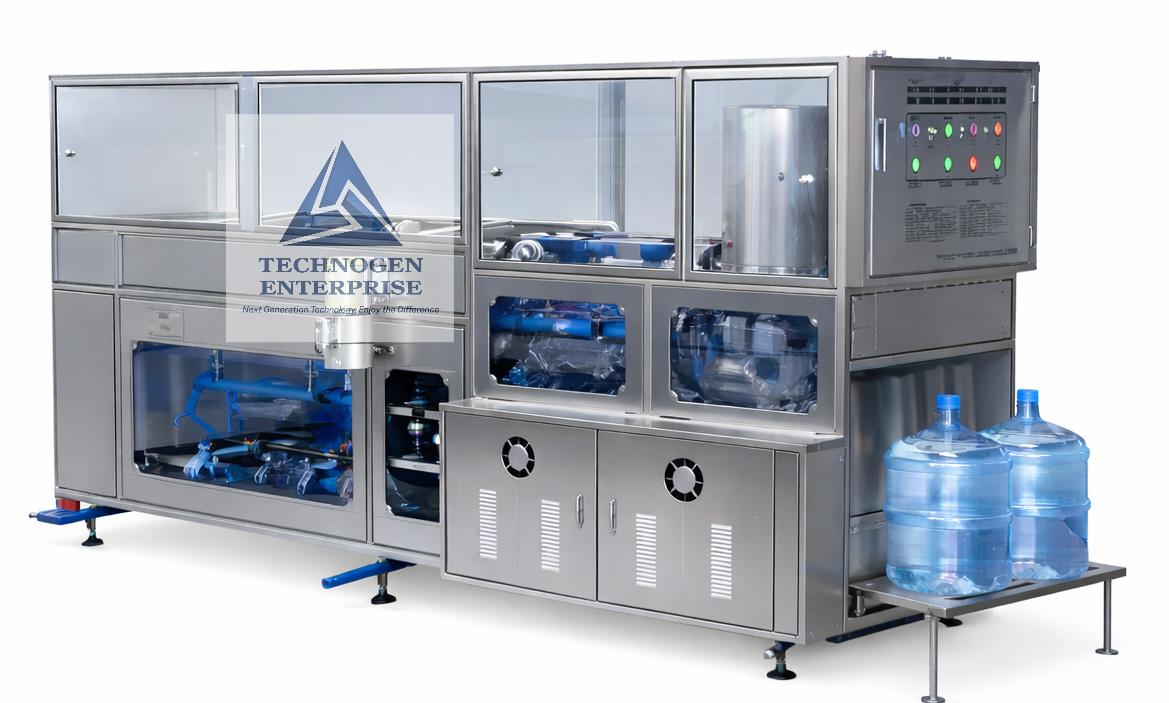
Jar RFC Lines
Automatic Mineral Water 20 Liter Jar Rinsing Filling Capping Machine
Integrated 20-litre water jar washing, filling and capping machine with three-stage washing, automatic cap feeding and processing, and manual jar loading and unloading.
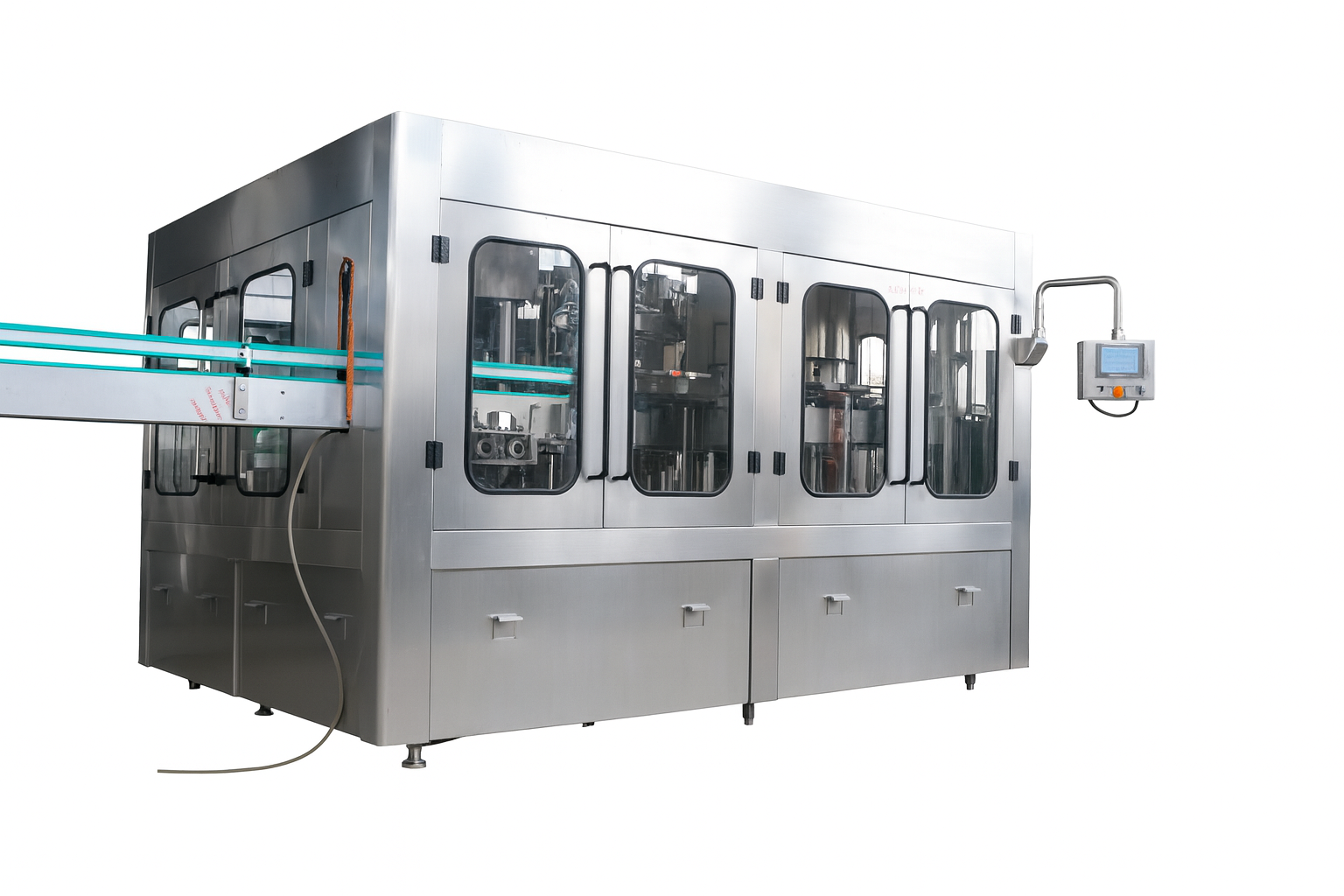
Carbonated Beverage RFC Lines
Automatic Plastic Bottle RFC Isobaric Carbonated Beverage Filling Machine
PET bottle rinsing, isobaric filling and plastic screw-capping monoblock for carbonated drinks. Engineered by Technogen Enterprise, Ahmedabad, India.
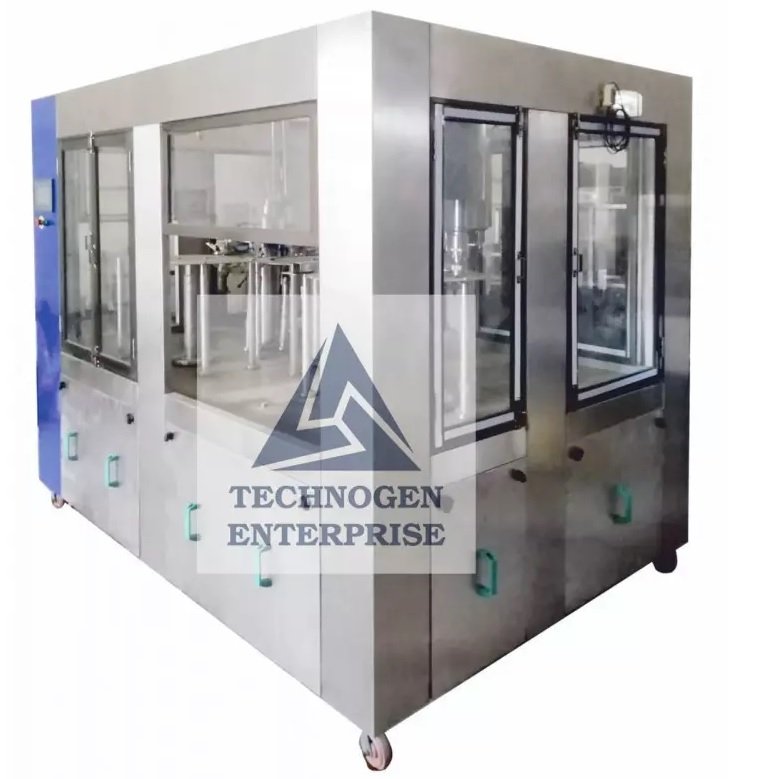
Water RFC Lines
Rinsing Filling Capping (RFC) Water Bottle Machine
Automatic rotary rinsing, filling and capping machine for 100 ml to 1000 ml water bottles, with neck holding, air-blow infeed conveyor, automatic screw capping and bottle-presence interlocks.
Request Technical Quote
Discuss Automatic Glass RFC Isobaric Carbonated Beverage Filling Machine with our engineering team.
Send glass bottle drawings, crown or ROPP cap details, CO₂ conditions and hourly capacity for RFC machine selection.