
Granulation Machinery / Blending Machines
Octagonal Blender
Dry-granule octagonal tumbler with model-dependent mixing capacity and optional enclosed charging. Engineered by Technogen Enterprise, Ahmedabad, India.
ISO 9001:2015Ahmedabad, IndiaManufacturer - Exporter
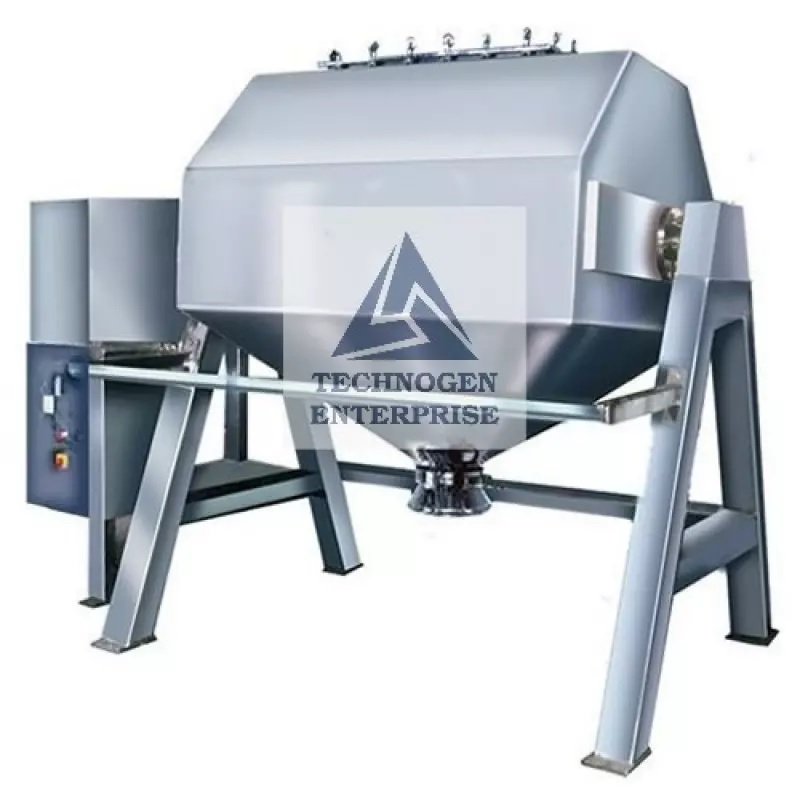
Octagonal BlenderMachine image shown for reference. Final configuration is selected against the approved application and production requirement.
01
Machine Overview
Technogen Enterprise offers the Octagonal Blender for dry granule mixing and lubrication duties in pharmaceutical, food, herbal, chemical and cosmetic manufacturing. Built around a rotating octagonal vessel, the blender creates continuous movement of the material bed at comparatively low rotational speeds. Its geometry is particularly suitable for blending granules that should be mixed evenly without the intensive action of a high-speed agitator.
The machine is commonly evaluated for pharmaceutical granulation lines where a uniform distribution of lubricants through dried granules is required before subsequent processing. The vessel's octagonal profile and internal removable baffles help move and redistribute the batch. The technical specification design allows top charging by hand and can be configured for bin charging or vacuum charging where the plant requires a more enclosed powder-handling route. A butterfly valve provides a controlled discharge path.
Technogen Enterprise, an Ahmedabad-based manufacturer, supplier and exporter of Octagonal Blenders, offers configurations identified by gross and working capacities. The published technical range includes TGOCB-100 to TGOCB-3000 models, with model-specific working volumes, speeds and dimensions. Buyers should select on actual usable batch volume, bulk density, blend sensitivity, charging arrangement and available installation space. The wide capacity range is intended to support both small-batch and industrial granule production.
02
Applications
03
Operating Principle
The Octagonal Blender blends by rotating its multi-sided chamber around a horizontal axis. The changing vessel profile continually lifts and redistributes the granules, helping the material move across different regions of the batch. This process is suited to dry granule blending and lubrication where controlled, repeatable movement is desirable.
Charging the Vessel
The operator charges dry granules or powder premix through the available charging point. The technical specification specifies manual top charging, bin charging and vacuum charging arrangements, depending on configuration. Working batch volume is selected for adequate free space during tumbling.
Selecting the Mixing Parameters
The blend duration and rotational speed are selected according to the formulation and installed model. The technical table provides different RPM ranges for the individual models, so a single speed value is not appropriate across the entire range.
Octagonal Tumbling
The vessel rotates and its angled faces repeatedly change how material is supported. Granules travel through the chamber while the removable baffles support redistribution, helping promote mixing at a measured rotational speed.
Ending the Cycle and Unloading
Once the specified mixing interval is complete, the drive is stopped and the discharge position is established. The butterfly valve allows the blended material to be transferred into an appropriate receiving vessel.
Cleaning and Preparation
Smooth stainless surfaces and access to removable components help the operator clean the blender between batches. Any charging accessories and the discharge valve must also be cleaned before a different product is introduced.
04
Salient Features
Rotating octagonal vessel for gentle blending of dry granules
Suitable for granule blending and lubrication applications
CGMP-style machine construction in specified configuration
Large batch handling with comparatively low drive power
Robust machine structure and covered drive assembly
Mirror-polished internal surfaces and matt-polished external frame
Removable internal baffles for batch movement and cleaning
Preset blending period according to formulation requirement
Butterfly valve for controlled product discharge
Top manual, bin or vacuum charging configurations described
Gear motor and gearbox housed under SS 304 covers
Compact installation footprint relative to some other blender shapes
05
Technical Specifications
Final specifications may vary with container size, product characteristics, selected model and approved configuration.
| MODEL | CAPACITY | WORKING CAPACITY | BLENDER (RPM) | OVERALL DIMENSIONS (L X W X H) MM |
|---|---|---|---|---|
| TGOCB-100 | 100 Ltrs Gross | 60 Liters | 5-22 | 1380 x 1100 x 1715 |
| TGOCB 150 | 150 Ltrs Gross | 90 Liters | 5-22 | 1428 x 1200 x 1865 |
| TGOCB 200 | 200 Ltrs Gross | 120 Liters | 2-16 | 1749 x 1400 x 2562 |
| TGOCB 250 | 250 Ltrs Gross | 150 Liters | 2-16 | 1795 x 1400 x 2562 |
| TGOCB 300 | 300 Ltrs Gross | 180 Liters | 2-16 | 1859 x 1400 x 2562 |
| TGOCB 500 | 500 Ltrs Gross | 300 Liters | 2-12 | 2540 x 2400 x 2570 |
| TGOCB 600 | 600 Ltrs Gross | 400 Liters | 2-12 | 2100 x 2023 x 2075 |
| TGOCB 1000 | 1000 Ltrs Gross | 600 Liters | 1-8 | 2905 x 2800 x 2115 |
| TGOCB 1500 | 1500 Ltrs Gross | 900 Liters | 1-8 | 3137 x 2900 x 2420 |
| TGOCB 2000 | 2000 Ltrs Gross | 1500 Liters | 6 | 2872 x 2720 x 2680 |
| TGOCB 3000 | 3000 Ltrs Gross | 2100 Liters | 4 | 2817 x 3190 x 2850 |
06
Add-On Features
Bin charging interface
Vacuum charging configuration
Dust-free charging arrangement
07
Applicable Industries
08
Frequently Asked Questions
What is an Octagonal Blender mainly used for?
The octagonal blender is used for blending and lubrication of dry granules, particularly in pharmaceutical production. It can also be evaluated for compatible food, herbal, cosmetic and chemical materials.
Why is an octagonal vessel useful for granule mixing?
Its multiple faces cause the granule bed to move as the vessel turns. This creates repeated redistribution at controlled speeds and helps blend ingredients with less aggressive processing than a high-shear mixer.
How do I choose between the TGOCB models?
The technical specification lists gross volume, working capacity, blender RPM and overall dimensions for each model. Working volume, granule density, cycle time and installation clearance should guide selection.
Can material be charged without an open manual transfer?
The technical specification identifies bin charging and vacuum charging as possible configurations, alongside manual top charging. The appropriate interface must be agreed for the process.
Is the octagonal blender suitable for liquid mixing?
The supplied machine is specified for dry granules and related dry blending duties. A liquid blending requirement should be evaluated against a different mixing technology rather than assumed suitable.
Related Machinery
Continue building your line.
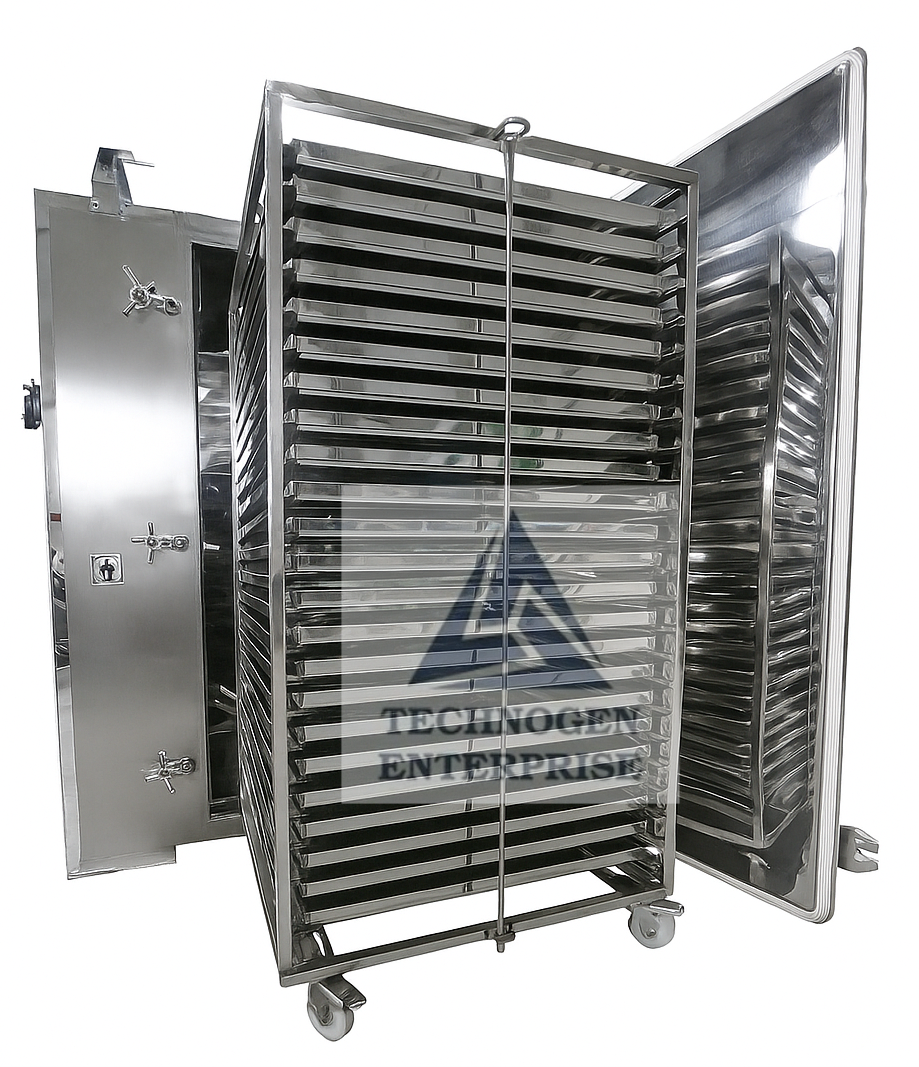
Drying Machines
Air Tray Dryer
Insulated batch hot-air tray dryer with TGTD-24, TGTD-48 and TGTD-96 configurations. Engineered by Technogen Enterprise, Ahmedabad, India.
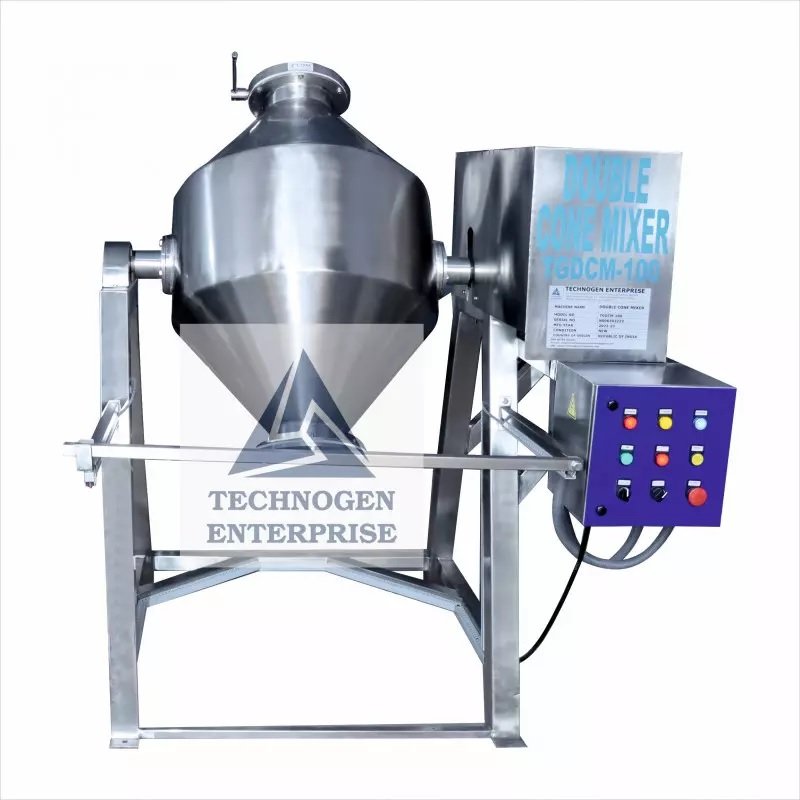
Blending Machines
Double Cone Blender
Dry powder and granule blender with double-conical rotating chamber and model-dependent stainless steel construction. Engineered by Technogen Enterprise, Ahmedabad, India.
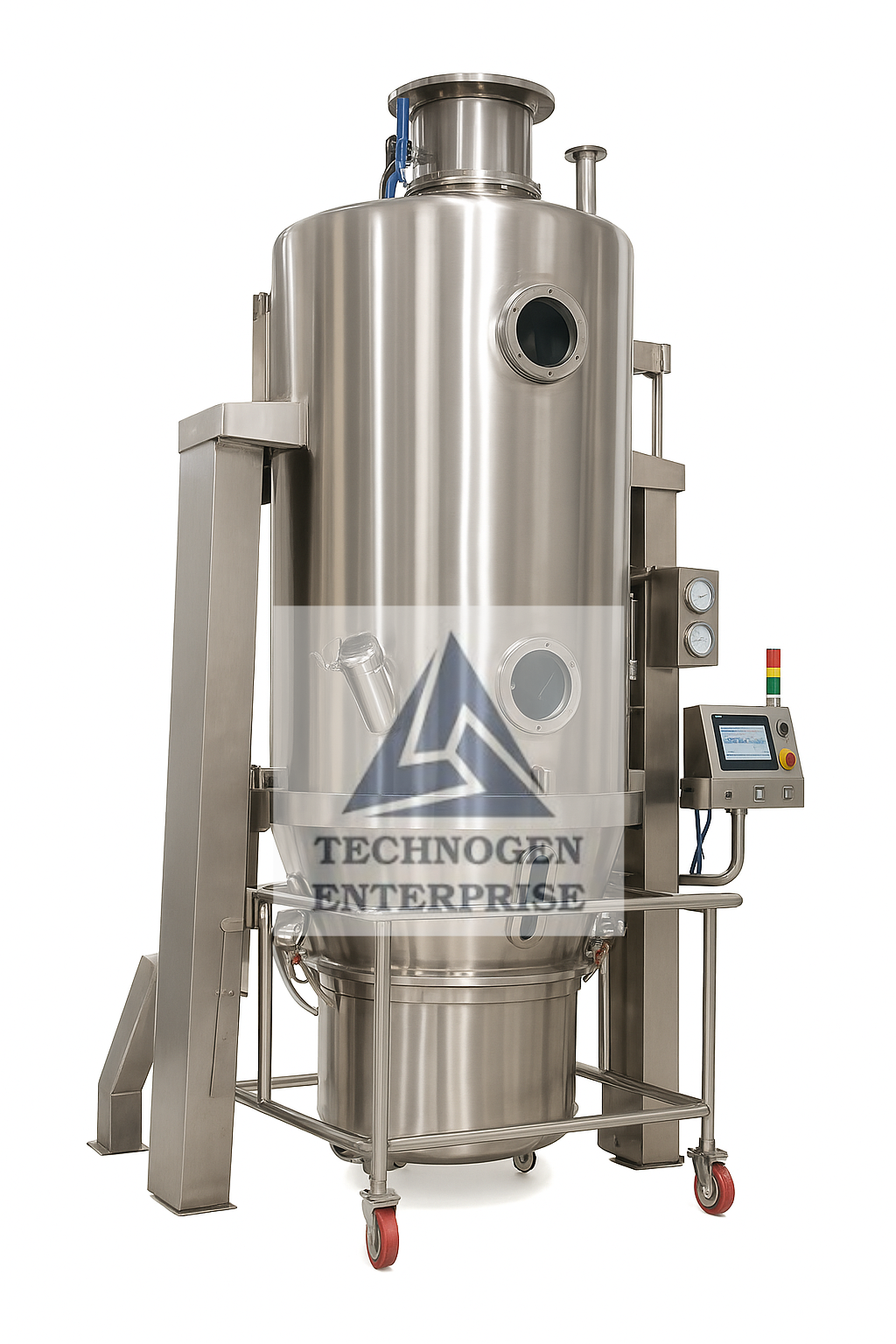
Drying Machines
Fluid Bed Dryer
Fluidised-bed batch dryer for granules and powders with TGFBD models and controlled heated airflow. Engineered by Technogen Enterprise, Ahmedabad, India.
Request Technical Quote
Discuss Octagonal Blender with our engineering team.
Send your granule characteristics, desired working capacity and charging preference for selection of an octagonal blender.